• moved by
2,335 views
6 6 votes

Consider the following square with the four corners and the center marked as $\text{P, Q, R, S}$ and $\text{T}$ respectively.
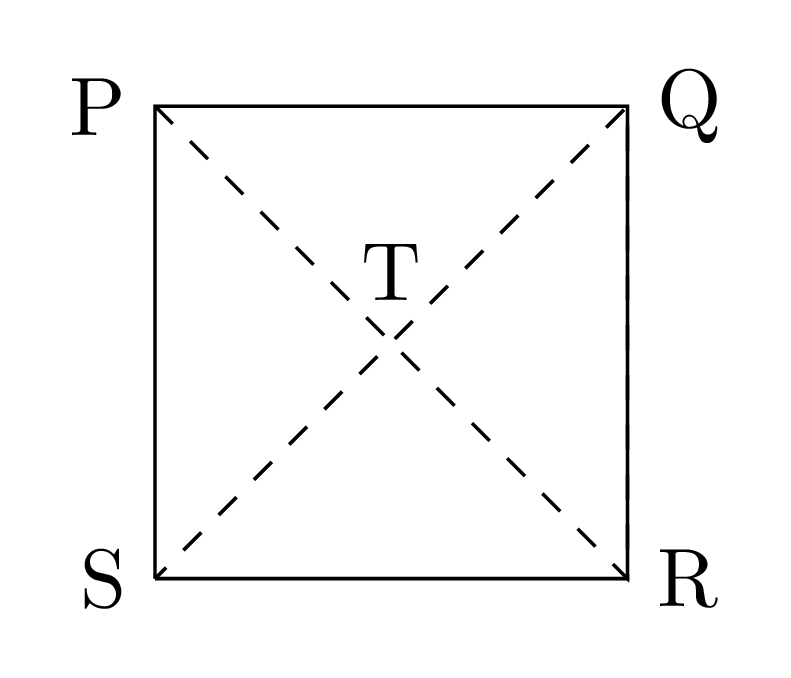
Let $\text{X, Y}$ and $\text{Z}$ represent the following operations:

$\text{X:}$ rotation of the square by $180$ degree with respect to the $\text{S – Q}$ axis.

$\text{Y:}$ rotation of the square by $180$ degree with respect to the $\text{P – R}$ axis.

$\text{Z:}$ rotation of the square by $90$ degree clockwise with respect to the axis perpendicular, going into the screen and passing through the point $\text{T}.$

Consider the following three distinct sequences of operation (which are applied in the left to right order).

  1. $\text{XYZZ}$
  2. $\text{XY}$
  3. $\text{ZZZZ}$

Which one of the following statements is correct as per the information provided above?

  1. The sequence of operations $(1)$ and $(2)$ are equivalent
  2. The sequence of operations $(1)$ and $(3)$ are equivalent
  3. The sequence of operations $(2)$ and $(3)$ are equivalent
  4. The sequence of operations $(1), (2)$ and $(3)$ are equivalent

2 Answers

Best answer
4 4 votes

Given that, the square:

 The  $\text{X, Y}$ and $\text{Z}$ represent the following operations:

  • ${\color{Magenta}{\text{X:}}}$ rotation of the square by $180$ degree with respect to the $\text{S – Q}$ axis.

  • ${\color{Green}{\text{Y:}}}$ rotation of the square by $180$ degree with respect to the $\text{P – R}$ axis.

  • ${\color{Orange}{\text{Z:}}}$ rotation of the square by $90$ degree clockwise with respect to the axis perpendicular, going into the screen and passing through the point $\text{T}.$

Consider the following three distinct sequences of operation (which are applied in the left to right order).

  1. ${\color{Red}{\text{XYZZ}:}}$


  1. ${\color{Blue}{\text{XY:}}}$

  1. ${\color{Purple}{\text{ZZZZ:}}}$

$\therefore$ The sequence of operations $(1)$ and $(3)$ are equivalent.

Correct Answer $:\text{B}$

• moved by
Answer:
Position:
Show:

Related questions

12 12 votes
2 2 answers
3.3k
3.3k views
Arjun asked Feb 15, 2022
3,309 views
The figure shows a grid formed by a collection of unit squares. The unshaded unit square in the grid represents a hole.What is the maximum number of squares without a “ho...
4 4 votes
3 answers 3 answers
2.1k
2.1k views
Arjun asked Feb 15, 2022
2,101 views
An art gallery engages a security guard to ensure that the items displayed are protected. The diagram below represents the plan of the gallery where the boundary walls ar...
0 0 votes
1 1 answer
265
265 views
gatecse asked Feb 23
265 views
\[\begin{aligned}&\text{If} \\[6pt]&\begin{array}{lll}\text{Ref Fig} & \rightarrow & \text{JS 3V} \\12\ \ 34 & & \text{B6t L!d}\end{array}\\[10pt]&\text...
6 6 votes
2 2 answers
2.0k
2.0k views
Arjun asked Feb 16, 2024
1,972 views
​​​Two identical sheets $\text{A}$ and $\text{B}$, of dimensions $24 \mathrm{~cm} \times 16 \mathrm{~cm}$, can be folded into half using two distinct operations, $\text{F...

Add Synced Question

×