• moved by
3,730 views
5 5 votes

A trapezium has vertices marked as $\text{P, Q, R}$ and $\text{S}$ (in that order anticlockwise). The side $\text{PQ}$ is parallel to side $\text{SR}.$

Further, it is given that, $\text{PQ = 11 cm, QR = 4 cm, RS = 6 cm}$ and $\text{SP = 3 cm.}$

What is the shortest distance between $\text{PQ}$ and $\text{SR (in cm)}?$

  1. $1.80$
  2. $2.40$
  3. $4.20$
  4. $5.76$

4 Answers

Best answer
11 11 votes

Let’s first draw the trapezium.         
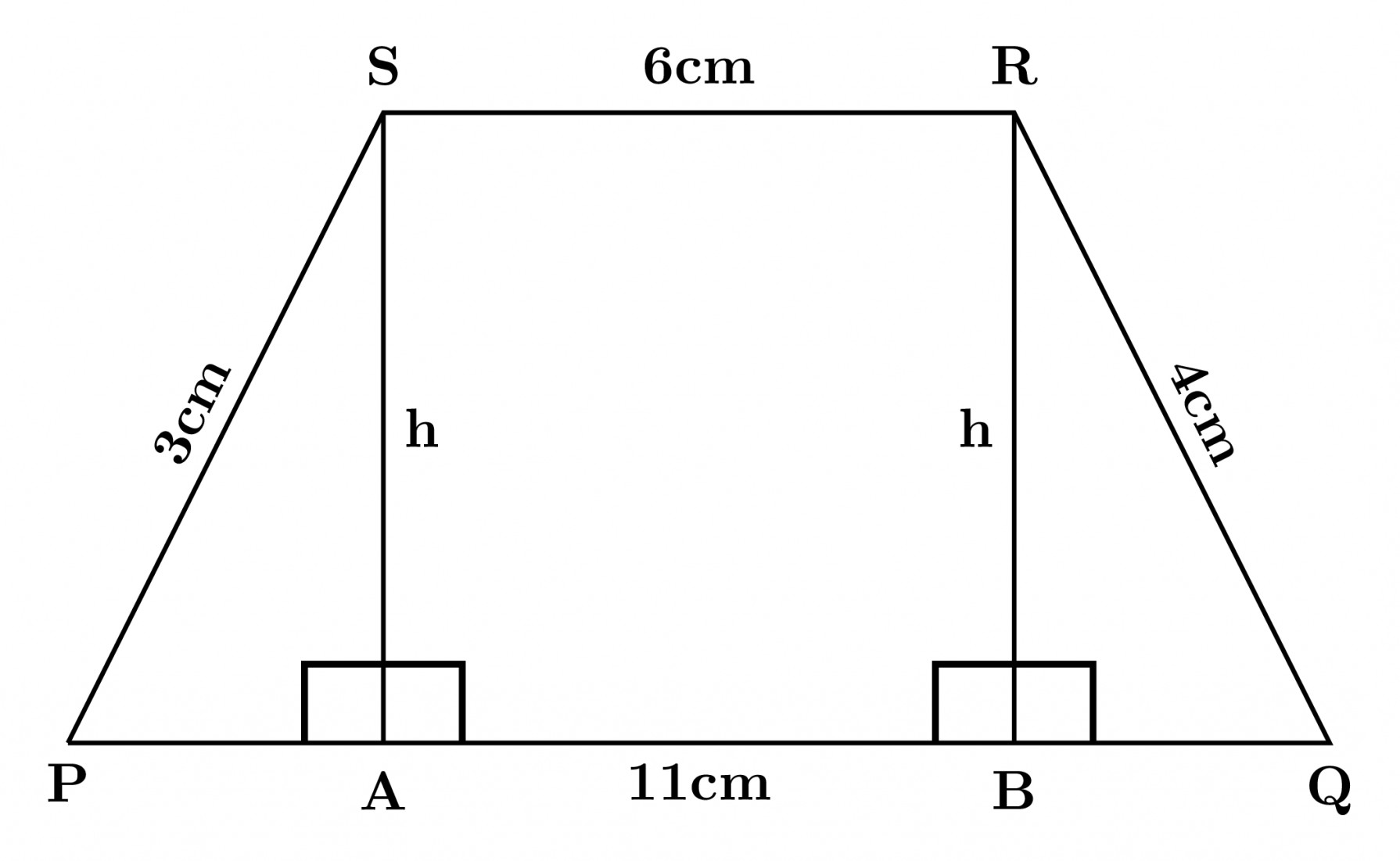
 Let the distance between $\text{RS},$ and $\text{PQ}$ be $h\;\text{cm}.$

Here, $\text{AB = 6 cm} \Rightarrow {\color{Blue}{\boxed{\text{PA + BQ = 5 cm}}}} \quad \longrightarrow (1)$

The $\triangle \text{PAS, QBR}$ are right angle triangle, so we can apply the Pythagorean theorem.

Now, in $\triangle \text{PAS},$

${\color{Green}{\text{(Hypotenuse)}^{2} = \text{(Perpendicular)}^{2} + \text{(Base)}^{2}}}$

$\Rightarrow (\text{PS})^{2} = (\text{AS})^{2} + (\text{PA})^{2}$

$\Rightarrow 3^{2} = h^{2} + (\text{PA})^{2}$

$\Rightarrow h^{2} + (\text{PA})^{2} = 9 \quad \longrightarrow (2)$

Now, in $\triangle \text{PAS},$

$\Rightarrow (\text{QR})^{2} = (\text{RB})^{2} + (\text{BQ})^{2}$

$\Rightarrow 4^{2} = h^{2} + (\text{BQ})^{2}$

$\Rightarrow h^{2} + (\text{BQ})^{2} = 16 \quad \longrightarrow (3)$

Subtract equation $(2)-(3).$

$\qquad \require{cancel}\begin{array}{} {\color{Red}{\cancel{h^{2}}}} + (\text{PA})^{2} = 9 \\ {\color{Red}{\cancel{h^{2}}}} + (\text{BQ})^{2} = 16 \\\; – \qquad \;\; – \qquad \quad  – \\\hline  (\text{PA})^{2} –  (\text{BQ})^{2} = -7 \end{array}$

$\Rightarrow (\text{PA – BQ}) (\text{PA + BQ}) = -7 \quad [{\color{Green}{\because a^{2} – b^{2} = (a+b)(a-b)}}]$

$\Rightarrow (\text{PA – BQ}) \cdot 5 = -7$

$\Rightarrow {\color{Blue}{\boxed{\text{PA – BQ} = \frac{-7}{5}\;\text{cm}}}}\quad \longrightarrow (4)$

Adding the equation $(1)\; \& \;(4),$ we get.

$\text{PA + BQ + PA – BQ} = 5 \;– \frac{7}{5} $

$\Rightarrow \text{2PA} = \frac{25-7}{5}$

$\Rightarrow \text{2PA} = \frac{18}{5}$

$\Rightarrow {\color{Blue}{\boxed{\text{PA} = \frac{9}{5}\;\text{cm}}}}$

Put the value of $\text{PA}$ in the equation $(1).$

$h^{2} + (\text{PA})^{2} = 9$

$\Rightarrow h^{2} + \left(\frac{9}{5}\right)^{2} = 9$

$\Rightarrow h^{2} + \frac{81}{25} = 9$

$\Rightarrow h^{2}  = 9 – \frac{81}{25}$

$\Rightarrow h^{2}  = \frac{225-81}{25}$

$\Rightarrow h^{2}  = \frac{144}{25}$

$\Rightarrow h  = \sqrt{\frac{144}{25}}$

$\Rightarrow h  = \frac{12}{5} = 2.40\;\text{cm}$

$\therefore$  The shortest distance between $\text{PQ}$ and $\text{SR (in cm)}$ is $2.40\;\text{cm}.$

Correct Answer $:\text{B}$

• selected by
4 4 votes

In $\triangle PQR$ in fig.(2),

$PQ^{2} = PR^{2} + RQ^{2} \Rightarrow \boxed{\angle PRQ = 90^{\circ}}$

So, $sin(\alpha) = \dfrac{QR}{PQ}$

$sin(\alpha) = \dfrac{4}{5}$

$\boxed{ \alpha = sin^{-1} \Big( \dfrac{4}{5} \Big) }$

Now, In $\triangle PTR$ in fig.(2),

$sin(\alpha) = \dfrac{RT}{PR}$

$sin \Big( sin^{-1} \Big( \dfrac{4}{5} \Big) \Big) = \dfrac{h}{3}$

$\dfrac{4}{5} = \dfrac{h}{3}$

$\dfrac{12}{5} = h$

$\boxed{h = 2.4cm}$

Alternate:

credit: @CJ_2024's comment

Area (trapezium PQRS) = Area (rectangle ABRS) + Area ($\triangle SAP$) + Area ($\triangle BQR$)

Area (trapezium PQRS) = Area (rectangle ABRS) + Area ($\triangle PQR$)

$\dfrac{1}{2} \times (6+11) \times h = 6 \times h \, +$ Area ($\triangle PQR$)

$\dfrac{17h}{2} = 6h \, +$ Area ($\triangle PQR$)

$\dfrac{17h}{2} - 6h = $ Area ($\triangle PQR$)

$\dfrac{17h - 12h}{2} = $ Area ($\triangle PQR$)

$\dfrac{5h}{2} = $ Area ($\triangle PQR$)

$h = \dfrac{2}{5} \times $ Area ($\triangle PQR$)           ................................(1)

Now, Using heron's formula of area of triangle:

$s = \dfrac{a+b+c}{2} = \dfrac{3+4+5}{2} = \dfrac{12}{2} = 6$

Area ($\triangle PQR$) $= \sqrt{s(s-a)(s-b)(s-c)}$

$= \sqrt{6(6-3)(6-4)(6-5)}$

$= \sqrt{6 \times 3 \times 2 \times 1}$

$= \sqrt{36}$

$= 6$

Now, putting value in eqn(1),

$h = \dfrac{2}{5} \times 6$

$h = \dfrac{12}{5}$

$\boxed{h = 2.4cm}$

• moved by
0 0 votes

checking option is best

options  C, D are cannot be h.

so A and B remains

checking A is correct ?

we need 11 - 6 = 5 

 root ( 3^2 - 1.8^2) + root ( 4^2 - 1.8^2) =  ?    it is not equal to 5

so option B only remains.   

• moved by
Answer:
Position:
Show:

Related questions

5 5 votes
3 3 answers
1.2k
1.2k views
Arjun asked Feb 15, 2022
1,182 views
A sum of money is to be distributed among $\text{P, Q, R,}$ and $\text{S}$ in the proportion $5:2:4:3,$ respectively.If $\text{R}$ gets ₹ $ 1000$ more than $\text{S},$ w...
2 2 votes
2 2 answers
905
905 views
Arjun asked Feb 15, 2022
905 views
Consider the following inequalities.$2x – 1 7$$2x – 9 < 1$Which one of the following expressions below satisfies the above two inequalities?$x \leq – 4$$ – 4 < x \leq 4$...
7 7 votes
3 3 answers
2.3k
2.3k views
Arjun asked Feb 15, 2022
2,292 views
Four points $\text{P(0, 1), Q(0, – 3), R( – 2, – 1),}$ and $\text{S(2, – 1)}$ represent the vertices of a quadrilateral.What is the area enclosed by the quadrilateral?$4$...
11 11 votes
2 2 answers
2.8k
2.8k views
Arjun asked Feb 16, 2024
2,751 views
​​​​​Four identical cylindrical chalk-sticks, each of radius $r=0.5 \mathrm{~cm}$ and length $l=10 \mathrm{~cm}$, are bound tightly together using a duct tape as shown in...

Add Synced Question

×