• moved by
1,897 views

3 Answers

Best answer
10 10 votes

Given that, corners are cut from an equilateral triangle to produce a regular convex hexagon. The smaller triangles cut are equilateral triangles (If we cut off corners to create a regular hexagon, then each angle of the hexagon is $120^{\circ}$, and so each angle of every removed triangle is $60^{\circ}$ making these triangles equilateral)

Let the original triangle side be $3a.$
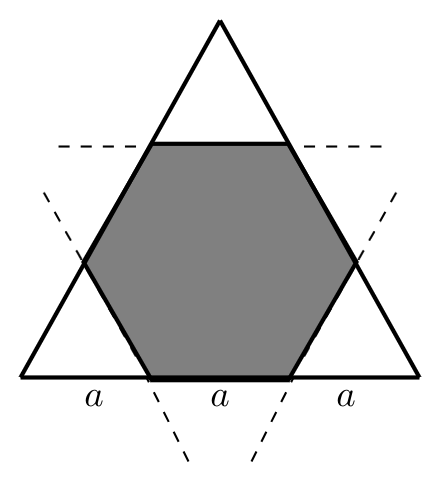
The area of regular convex hexagon $H_{1} = \frac{3\sqrt{3}}{2}s^{2},$ the area of equilateral triangle $ T_{1}= \frac{\sqrt{3}}{4}s^{2},$ where $s$ is the side length. 

Now, $H_{1} = \frac{3\sqrt{3}}{2}a^{2},A_{1} = \frac{\sqrt{3}}{4}(3a)^{2} = \frac{9\sqrt{3}}{4}a^{2}$

The required ratio $ = \dfrac{H_{1}}{A_{1}} = \dfrac{\frac{3\sqrt{3}}{2}a^{2}}{\frac{9\sqrt{3}}{4}a^{2}} = \frac{2}{3}.$

$\therefore$ The ratio of the area of the regular convex hexagon to the area of the original equilateral triangle is $2:3.$

So, the correct answer is $(A).$

• edited by
4 4 votes

i have very nice answer for this qeustion if there is regular hexagon then it's diagonals will create six equlateral traingles by joining them we can see the remaining three traingles are also the same as other six traingle so the ratio will be 2:3

• moved by
Answer:
Position:
Show:

Related questions

13 13 votes
1 answers 1 answer
658
658 views
Milicevic3306 asked Mar 27, 2018
658 views
A wire of length $340$ mm is to be cut into two parts. One of the parts is to be made into a square and the other into a rectangle where sides are in the ratio of $1:2$. ...
15 15 votes
5 answers 5 answers
4.5k
4.5k views
go_editor asked Feb 13, 2020
4,488 views
A circle with centre $\text{O}$ is shown in the figure. A rectangle $\text{PQRS}$ of maximum possible area is inscribed in the circle. If the radius of the circle is $a$,...
9 9 votes
3 answers 3 answers
1.3k
1.3k views
Arjun asked Feb 19, 2021
1,306 views
The current population of a city is $11,02,500$ . If it has been increasing at the rate of $5\%$ per annum, what was its population $2$ years ago?$9,92,500$$9,95,006$$10,...
13 13 votes
4 answers 4 answers
1.5k
1.5k views
Arjun asked Feb 19, 2021
1,519 views
$p$ and $q$ are positive integers and $\dfrac{p}{q}+\dfrac{q}{p}=3,$ then, $\dfrac{p^{2}}{q^{2}}+\dfrac{q^{2}}{p^{2}}=$$3$$7$$9$$11$

Add Synced Question

×